This decision gets made emotionally more often than commercially. New store owners over-invest in a custom build before they have proven demand; established stores under-invest and leave conversion revenue on the table for years.
Here is the commercial way to decide.
What a premium theme actually gives you
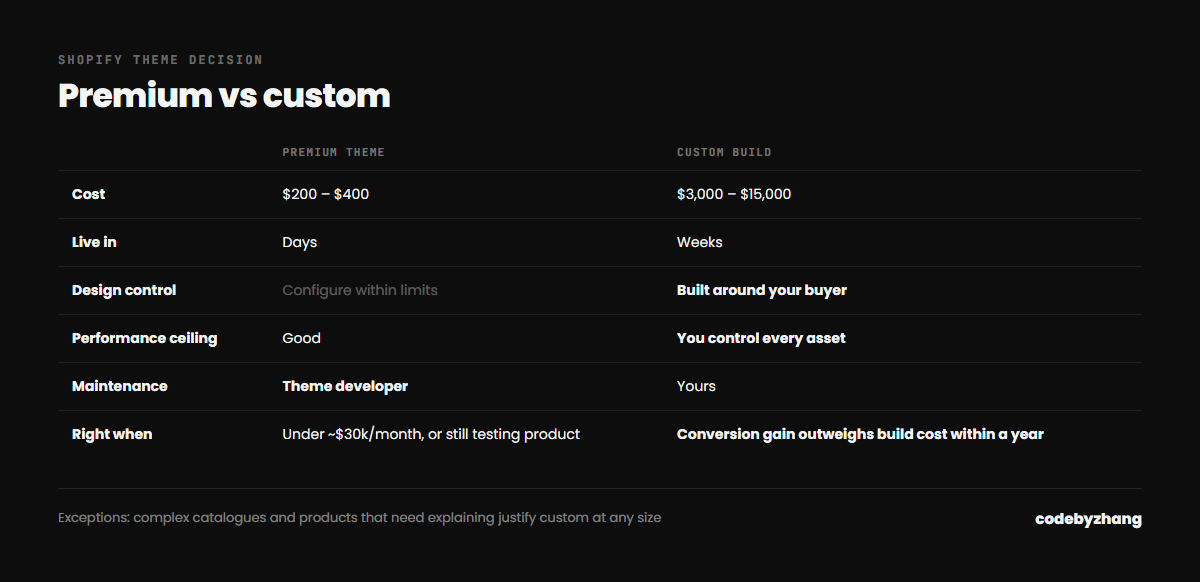
A good premium theme from the Shopify Theme Store costs $200–$400 and gives you a professionally designed, tested, mobile-responsive storefront with ongoing updates. For most new stores this is the correct choice, and it is not a compromise.
Strengths: fast to launch, low cost, tested across devices, maintained by the developer, and usually well-optimised out of the box.
Limits: you are configuring, not designing. Anything the theme did not anticipate becomes a customisation, and stacked customisations on a theme that keeps updating is where technical debt starts.
What a custom theme gives you
A custom theme is built around your products, your buyers and your specific path to checkout. It costs meaningfully more and takes weeks rather than hours.
Strengths: a buying experience designed for how your customers actually decide, complete control of performance and markup, no fighting theme updates, and the ability to build merchandising logic that templates do not offer.
Limits: cost, timeline, and the fact that you now own maintenance.
The threshold
The honest test is arithmetic. A custom build is worth commissioning when a realistic conversion rate improvement pays for it inside a year.
If your store does $10,000 a month, a 15% conversion improvement is $18,000 a year — that may or may not clear a custom build’s cost. At $60,000 a month, the same improvement is $108,000 a year, and the decision stops being close.
Below roughly $30,000 a month, your money almost always returns more when spent on traffic, product photography and merchandising than on a bespoke theme.
The exceptions
Revenue is not the only trigger. Commission a custom build regardless of size if:
- Your product needs explaining. Supplements, technical equipment and anything with compatibility rules need a buying flow templates do not provide.
- You have a complex catalogue. Large variant matrices, bundles or configurable products break most templates.
- You have a genuine brand position to protect. If looking identical to competitors costs you, that is a real commercial reason.
- You have already stacked heavy customisation on a premium theme. At some point the accumulated patches cost more to maintain than a clean build would have.
The middle path most stores should take
Start on a premium theme. Instrument it properly — analytics, funnel tracking, session recording. Run for a few months and find out where buyers actually drop off.
Then commission a custom build informed by that data, rather than by a designer’s assumptions. A custom theme built on real behavioural evidence outperforms one built on taste, almost every time.
What to ask a developer
- Will this pass Core Web Vitals on mobile, and will you show me the field data after launch?
- What can my team edit without calling you?
- How do apps integrate, and what happens to the theme when I add one?
- Who owns the code, and can another developer pick it up?
I build custom Shopify themes and also built Buy Buddy, an AI sales assistant running on live stores — so the conversion side is not theoretical. If you are weighing this up, tell me your numbers and I will give you a straight answer, including “stay on the premium theme” if that is the right call.