“How much does a website cost?” is the hardest question in this industry to answer honestly, because the same phrase covers a five-page brochure site and a banking platform. Both are “a WordPress website”. They are not the same job.
Here is how the numbers actually break down, based on the kind of work I take on for banks, agencies and international brands.
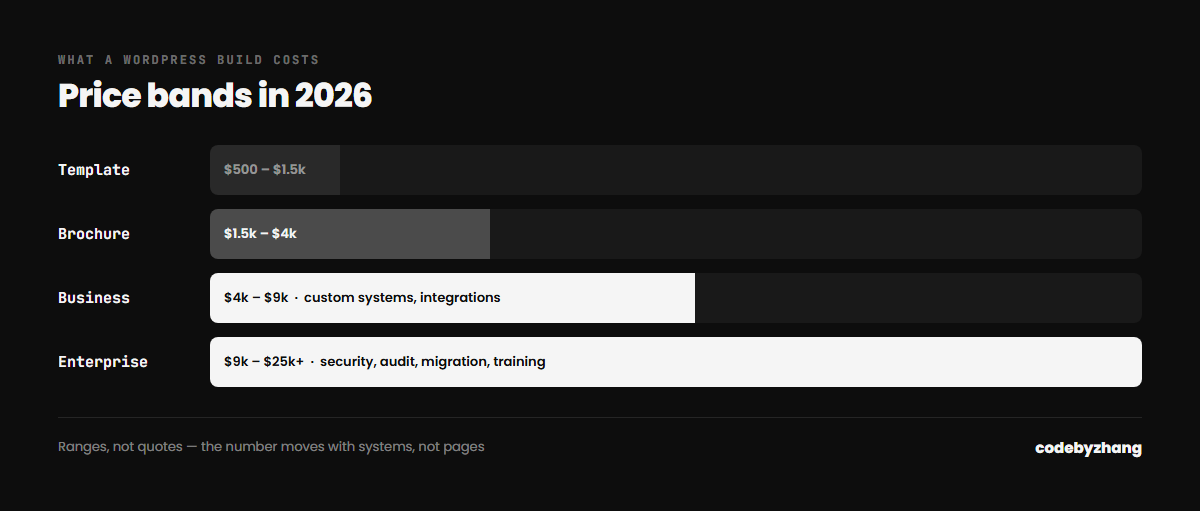
Typical price bands in 2026
| Type of build | Typical range | What you get |
|---|---|---|
| Template customisation | $500 – $1,500 | A premium theme configured with your branding and content. Fast, but you inherit the theme’s limits. |
| Custom brochure site | $1,500 – $4,000 | A bespoke design, built to your content model. Editable without a developer. |
| Business site with custom systems | $4,000 – $9,000 | Custom post types, integrations, multi-language, calculators or member areas. |
| Enterprise / regulated | $9,000 – $25,000+ | Security hardening, audit requirements, complex content architecture, staged rollout, training and handover. |
These are ranges, not quotes. Two projects with identical page counts can differ by a factor of five once you look at what sits behind the pages.
What actually drives the price
1. Custom systems, not page count
Adding the eleventh page to a site costs almost nothing. Adding the first booking system, pricing calculator or CRM integration costs a great deal. When you brief a developer, list your systems, not your pages — that is the part that moves the number.
2. Who has to edit it afterwards
A site only you will ever touch is cheap. A site a marketing team of six will edit weekly needs a real content architecture — custom fields, guardrails, and a structure that does not break when somebody pastes in a 400-word paragraph. That work is invisible on launch day and is the single biggest driver of whether a site survives two years.
3. Integrations
Every third-party system — payment gateway, CRM, ERP, logistics provider, booking engine — is its own small project. Each one has its own API, its own failure modes, and its own edge cases nobody documents. Budget per integration, not as a lump.
4. Content and migration
Moving 200 existing pages while preserving URLs, redirects and rankings is a genuine workstream. It is routinely left out of quotes and then discovered in week three.
Where budgets get wasted
- Paying for a redesign you will need again in 18 months. If the build has no content architecture, the next redesign is another full rebuild, not an evolution.
- Buying a page builder plugin as a strategy. Drag-and-drop builders are fast on day one and expensive on day four hundred, when the markup they generate makes performance and accessibility work far harder.
- Skipping technical SEO until “after launch”. Retrofitting structured data, URL structure and performance is several times more expensive than building it in.
- Not budgeting for a staging environment. Testing in production always costs more than the staging server would have.
What a fair quote looks like
A quote worth trusting should tell you: exactly what is included, what is explicitly excluded, what happens when scope changes, who owns the code and hosting afterwards, and what support looks like once you are live. If a quote is a single number with no breakdown, you cannot compare it to anything.
I publish indicative scopes on my packages page for exactly this reason — so you can see what sits inside a number before you talk to anyone.
How to reduce the cost honestly
- Phase it. Launch the pages that earn money first. Add the member area in phase two, once it is paying for itself.
- Have your content ready. Waiting on copy is the most common cause of a project running long, and long projects cost more.
- Decide who owns decisions. One decision-maker moves faster than a committee, and speed is most of the budget.
- Do not over-specify the CMS. Build editing tools for the content you will actually change, not for every hypothetical.
If you would like a real number rather than a range, send me a short brief on the contact page. You will get a clear scope, timeline and fixed price back within 24 hours.