I built Buy Buddy, an AI sales assistant now running on live supplement and peptide stores. So I have a commercial interest here, and I would rather be straight with you than oversell it: on a large number of Shopify stores, a chatbot is a waste of money.
Here is how to tell which kind of store you have.
The one question that decides it
Do your customers arrive with questions your product page does not answer?
If someone is buying a printed t-shirt, they need a size chart and good photography — not a conversation. If someone is buying a nootropic stack, a replacement part, or anything with dosage, compatibility or regulatory nuance, they have real questions, and unanswered questions become abandoned carts.
Where chatbots genuinely earn their place
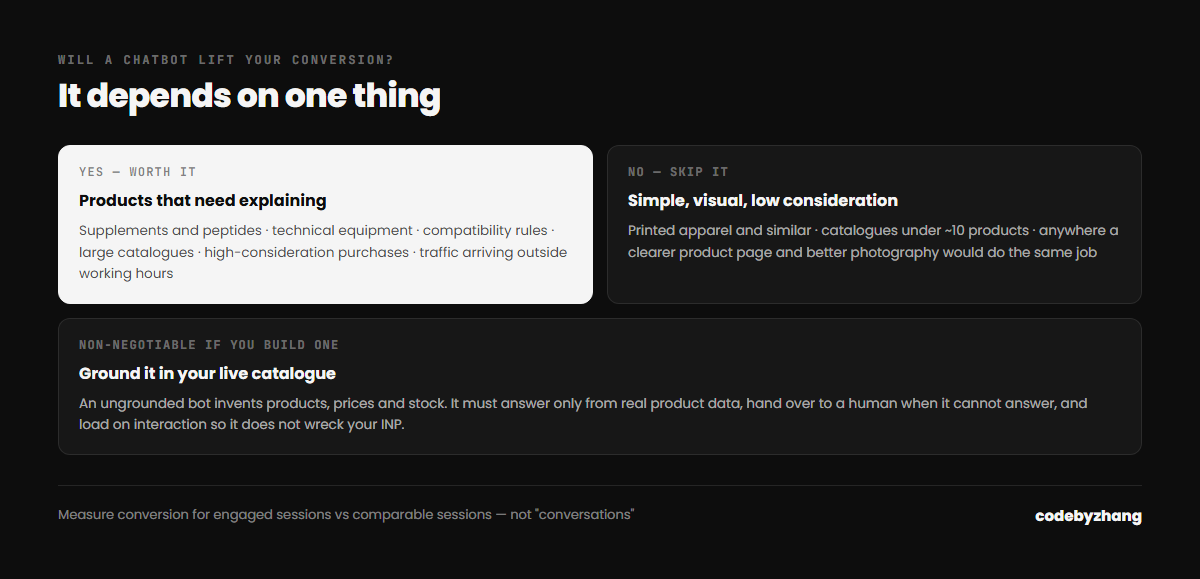
- Products that need explaining. Supplements, technical equipment, anything with compatibility rules or a learning curve.
- Large catalogues. When a filter interface still leaves 200 candidates, “tell me what you’re looking for” narrows it faster than faceted search.
- High-consideration purchases. The more expensive the item, the more reassurance a buyer needs before committing.
- Outside working hours. This is the quiet one. A significant share of e-commerce traffic arrives when nobody is at a desk. The alternative to the bot is not a human — it is silence.
Where they do not
- Simple, visual, low-cost products. Good photos and a clear returns policy do more.
- Very small catalogues. If you sell six things, navigation is not the problem.
- As a substitute for a bad product page. If buyers need a bot to find your shipping policy, fix the page.
What separates a useful bot from an annoying one
It must be grounded in your actual catalogue
This is the whole game. A bot running on a general model will confidently invent products, prices and stock levels. A grounded bot answers only from your live product data — real SKUs, real prices, real availability. Anything else creates support tickets and destroys trust.
It must know when to stop
A good assistant recognises when it cannot help and hands over to a human or a contact form. One that keeps generating plausible answers to questions it cannot answer is worse than no bot at all.
It must not ambush people
An auto-opening window three seconds after landing is the fastest way to make the bot into an obstacle. Trigger on intent — time on a product page, an exit signal, a second visit.
It must be fast and quiet on mobile
Chat widgets are among the heaviest third-party scripts on a typical store and a common cause of poor Interaction to Next Paint. Load it on interaction, not on page load, or you will trade conversion on one metric for conversion on another.
How to measure it honestly
Do not measure “conversations”. Measure conversion rate for sessions that engaged with the bot against comparable sessions that did not, and watch overall store conversion before and after launch. Also watch bounce rate and mobile performance — a chatbot that lifts assisted conversion while slowing every page can be net negative.
Run it as a test with a defined window and an honest decision at the end, including the decision to remove it.
The realistic expectation
On the right store, a well-built assistant meaningfully improves conversion for the sessions that use it, and its clearest value is answering questions at hours when nobody else can. On the wrong store, it is a script tax on your page speed.
You can read how Buy Buddy is built on my AI tools page. If you want an honest read on whether your store is the right kind, tell me what you sell — I will say so if it is not.